The cost-of-living gap: what retirees spend against what CPF pays

Singapore households made up only of non-working people aged 65 and over spent S$2,349 a month on average in 2023. OCBC's 2024 index puts a basic retirement at S$2,725 a month per person and a mid-range one at S$3,430. CPF LIFE at the Full Retirement Sum pays about S$1,780 a month from 65. For most couples the gap is real, and it is widest for the lifestyle they say they want.
What people fear most
Cost of living is the top concern in every recent survey. In YouGov's 2025 poll it led for 83% of Singaporeans. In May 2026 the pressures named most were household energy (70%), groceries (56%) and transport (50%), felt most by older respondents. Prudential's 2025 poll found 75% pointing to the high cost of living and 50% to income that does not keep up.
What retirees actually spend
| Measure | Monthly | Source |
|---|---|---|
| Households of non-working persons aged 65+, average spending (2023) | S$2,349 per household | SingStat HES 2023 |
| OCBC basic retirement | S$2,725 per person | OCBC 2024 |
| OCBC mid-range retirement | S$3,430 per person | OCBC 2024 |
| OCBC high-end retirement | S$6,150 per person | OCBC 2024 |
OCBC also found that 75% of people in their sixties who picked the most basic lifestyle underestimated its cost, by 22%.
What CPF LIFE pays
For the 2026 cohort, the estimated payouts from 65 are about S$950 a month at the Basic Retirement Sum, S$1,780 at the Full and S$3,440 at the Enhanced (Standard Plan). A couple who each reach the Full sum draws about S$3,560 a month together: more than the 2023 spending of a retired household, but short of two basic lifestyles by OCBC's measure, and short of two mid-range ones by about S$3,300.
Closing the gap
The gap is usually closed by one of three things: working longer (the re-employment age rises to 69 from 1 July 2026), spending less, or making the home pay. The third is the one households under-use because it feels like the home is untouchable. Freedom Age shows what the home could pay each month, and from what age, if it is kept, rented, right-sized or sold at the age you choose.
A worked example: a couple of 62 and 60 in a fully paid 5-room flat
The worked example follows a couple of 62 and 60 in a fully paid 5-room flat in District 18 worth S$750,000, with S$180,000 of CPF used on it. They earn S$4,000 and S$2,000 a month and want S$3,500 a month in retirement.
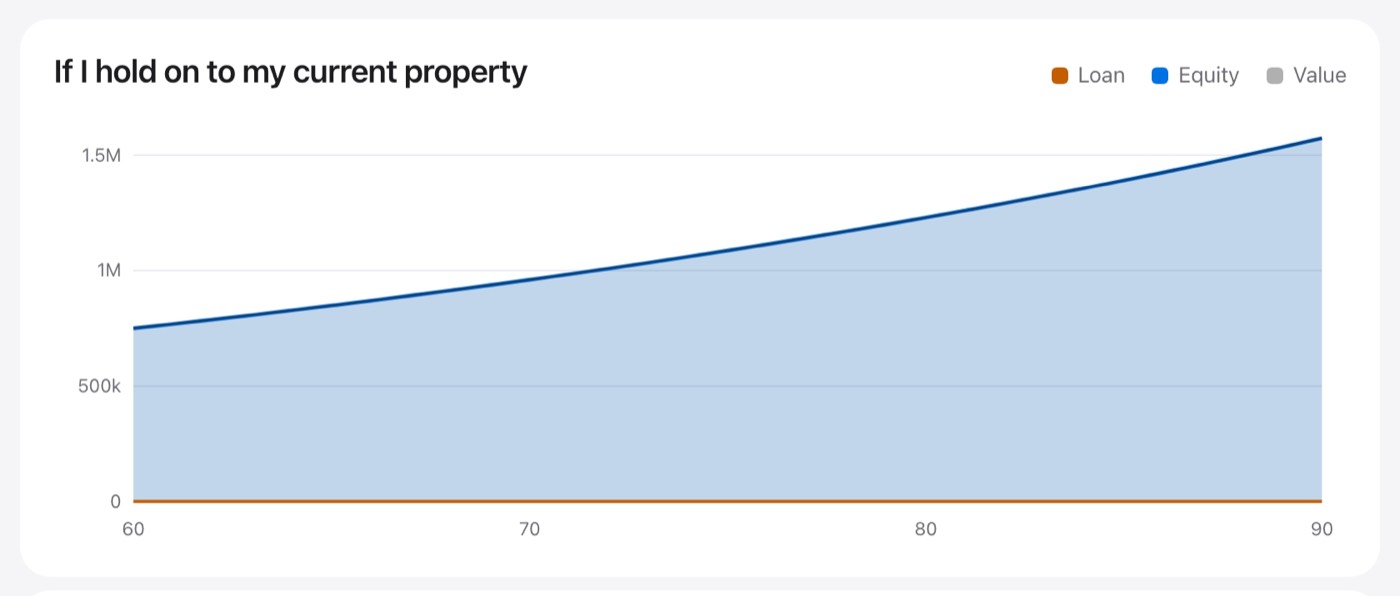
Keeping the flat, Freedom Age shows it worth about S$848,556 at 65, with nothing owed. That is wealth, but not income: it pays nothing a month until something is done with it. Their chosen move is to sell and buy a smaller home with cash in hand.
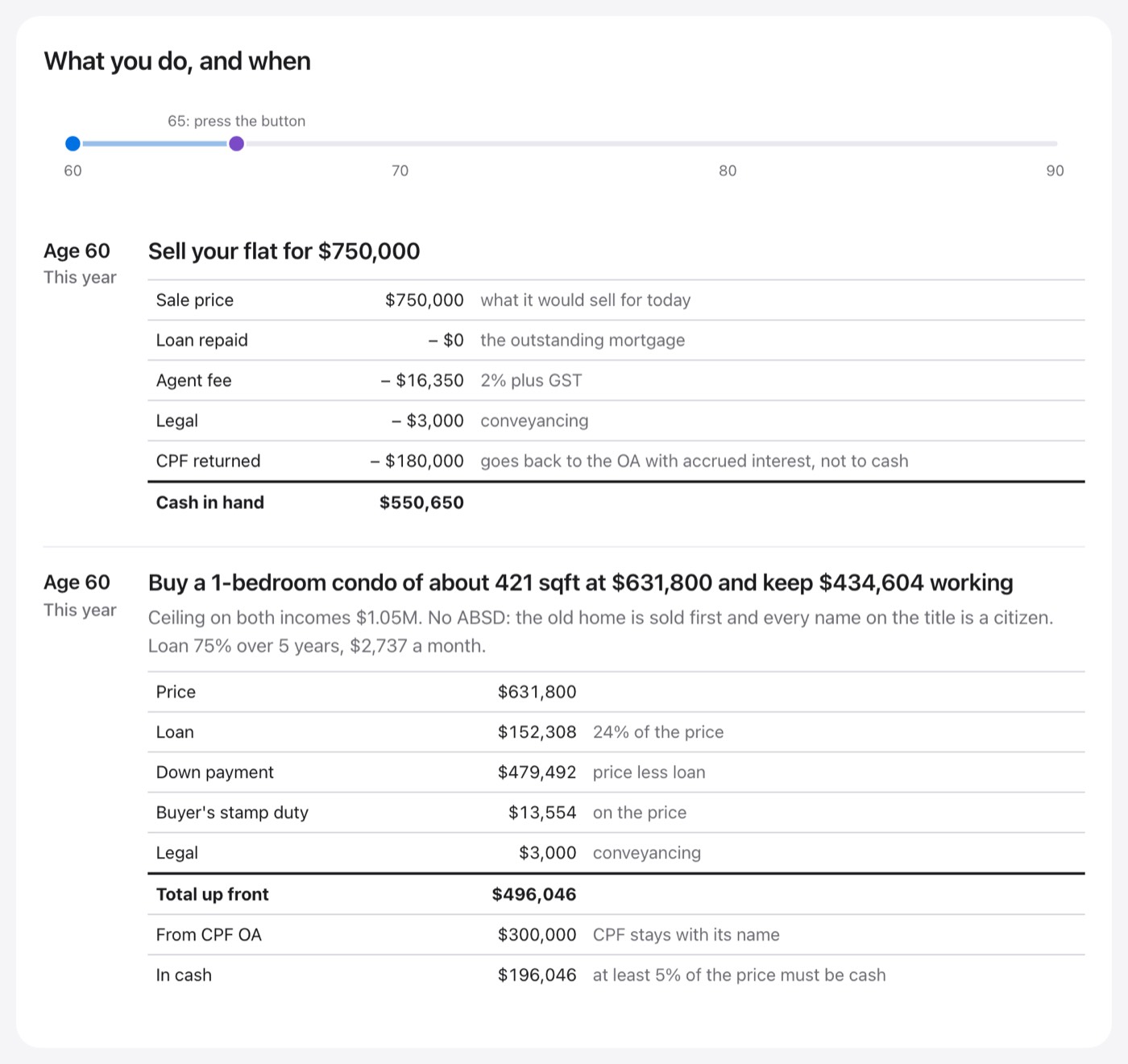
| The sale | |
|---|---|
| Sale price | S$750,000 |
| Agent fee (2% plus GST) | − S$16,350 |
| Legal | − S$3,000 |
| CPF returned to the Ordinary Accounts | − S$180,000 |
| Cash in hand | S$550,650 |
The tool sizes the next home to what the bank would lend and what keeps money working: a 1-bedroom condominium of about 421 square feet at S$631,800, a short loan over five years at S$2,737 a month, and S$434,604 kept invested. The move turns a home that pays nothing into a smaller home plus a pot that pays, at the cost of a loan into their mid-sixties.
A monthly budget test
- List your fixed costs: conservancy or maintenance, utilities, phone, insurance premiums.
- Add food and transport, the two items older households feel most.
- Add a healthcare line that grows with age.
- Set it against CPF LIFE for each of you, and what your home could pay.
- The gap is what the plan must close.
Where the gap usually closes
Most couples close it with a mix of work into their mid-sixties, a smaller home, and part of the home's value turned into income. The example household above shows the smaller-home route: a fully paid 5-room flat that pays nothing becomes a smaller home plus about S$434,604 kept working.
The gap grows with prices
The cost of living in retirement is not fixed, so the gap does not stay the same size. At 2% inflation a S$1,000 gap today is about S$1,219 in 10 years and S$1,486 in 20 (S$1,000 × 1.0210 and × 1.0220). A plan that closes today's gap with a fixed income will open it again later; part of the answer should be an income that can rise, such as rent.
Common mistakes
- Using today's prices for a 25-year retirement. Test the plan at 2% and at 3%.
- Counting both CPF LIFE payouts as household spending money. Premiums, care and one-off costs come out of the same income.
- Ignoring the home. A paid-off flat is the largest source most couples have to close the gap.
The bottom line
For most couples, CPF LIFE covers basic needs but not the retirement they want, and the gap grows with the cost of living. Work, a smaller home and a home that pays are the usual ways to close it.
See a worked example in Freedom Age, then find the age your own home could start paying you: five questions, free.
Open the worked example
Questions people ask
- How much does a retired couple need a month in Singapore?
- OCBC's 2024 figures are S$2,725 per person for a basic lifestyle and S$3,430 for a mid-range one. Households of non-working seniors spent S$2,349 on average in 2023 (SingStat), which reflects many living frugally.
- Is the Full Retirement Sum enough?
- It pays about S$1,780 a month from 65 for the 2026 cohort: below OCBC's basic lifestyle per person, so most people need another source for anything above basics.
- What costs rise fastest for older households?
- In May 2026, older respondents felt household energy and groceries most (YouGov). Healthcare premiums also rise with age.
- What is a basic retirement budget in Singapore?
- OCBC's 2024 index uses S$2,725 a month per person; retired households of non-working seniors spent S$2,349 on average in 2023.
- How much will my retirement costs rise?
- At 2% a year, prices rise by about 22% in 10 years and 49% in 20. MAS expects 1.5% to 2.5% in 2026.
Sources
- YouGov, Singaporeans brace for challenging times ahead (1 July 2025)
- YouGov, Consumer sentiment weakens as cost-of-living concerns rise (12 May 2026)
- Prudential Singapore SG60 financial future poll (2025)
- SingStat, Household Expenditure Survey 2023: households of non-working persons aged 65 and over
- OCBC Financial Wellness Index 2024 (retirement lifestyle costs)
- CPF Board, What is the CPF retirement sum (2026 sums and payout estimates)