Healthcare costs in retirement: the bill most plans leave out

Healthcare is the second-biggest money fear in Singapore after the cost of living: 56% named it in Prudential's 2025 poll. MediShield Life premiums are rising by up to 35%, phased from April 2025 to March 2028, and premiums climb steeply with age. A retirement plan that counts only living costs will come up short in its later years.
Premiums rise with age
Once the current increases are fully phased in, MediShield Life premiums at 75 are about S$924 to S$1,200 a year, and at 85 about S$1,560 to S$2,016 a year (MOH). The Government is adding S$4.1 billion of support against S$1.8 billion of premium increases, so most people's net increase is smaller, but the direction with age is up.
Why a level income struggles
CPF LIFE's Standard Plan pays the same every month. Healthcare costs rise with age and with prices at once. The years when care is most likely are the years when a level payout buys least. A plan should hold a reserve that grows, or an income that does.
Where a home helps
A home kept as a paid-off asset is also the reserve of last resort. A household that knows the age its home could start paying it, and what it would leave in cash, can decide how much to set aside for care without guessing. Freedom Age's buckets include a cash reserve for exactly this.
A worked example: a couple of 62 and 60 in a fully paid 5-room flat
The worked example follows a couple of 62 and 60 in a fully paid 5-room flat in District 18 worth S$750,000, with S$180,000 of CPF used on it. They earn S$4,000 and S$2,000 a month and want S$3,500 a month in retirement.
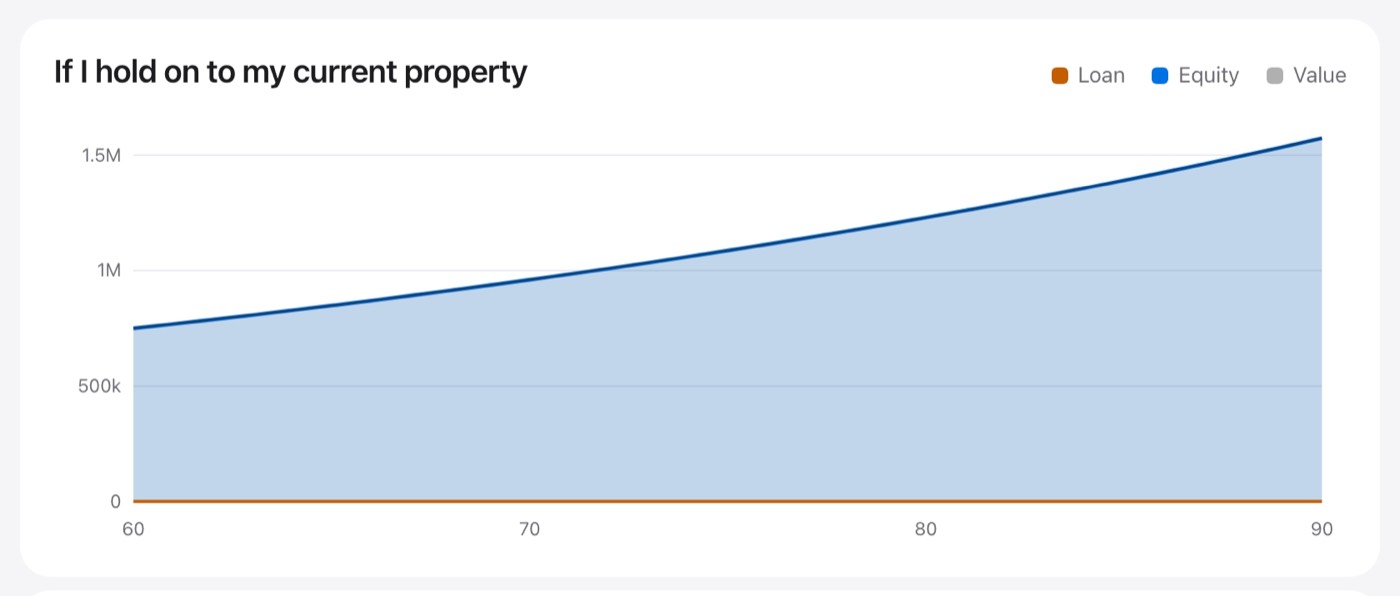
Keeping the flat, Freedom Age shows it worth about S$848,556 at 65, with nothing owed. That is wealth, but not income: it pays nothing a month until something is done with it. Their chosen move is to sell and buy a smaller home with cash in hand.
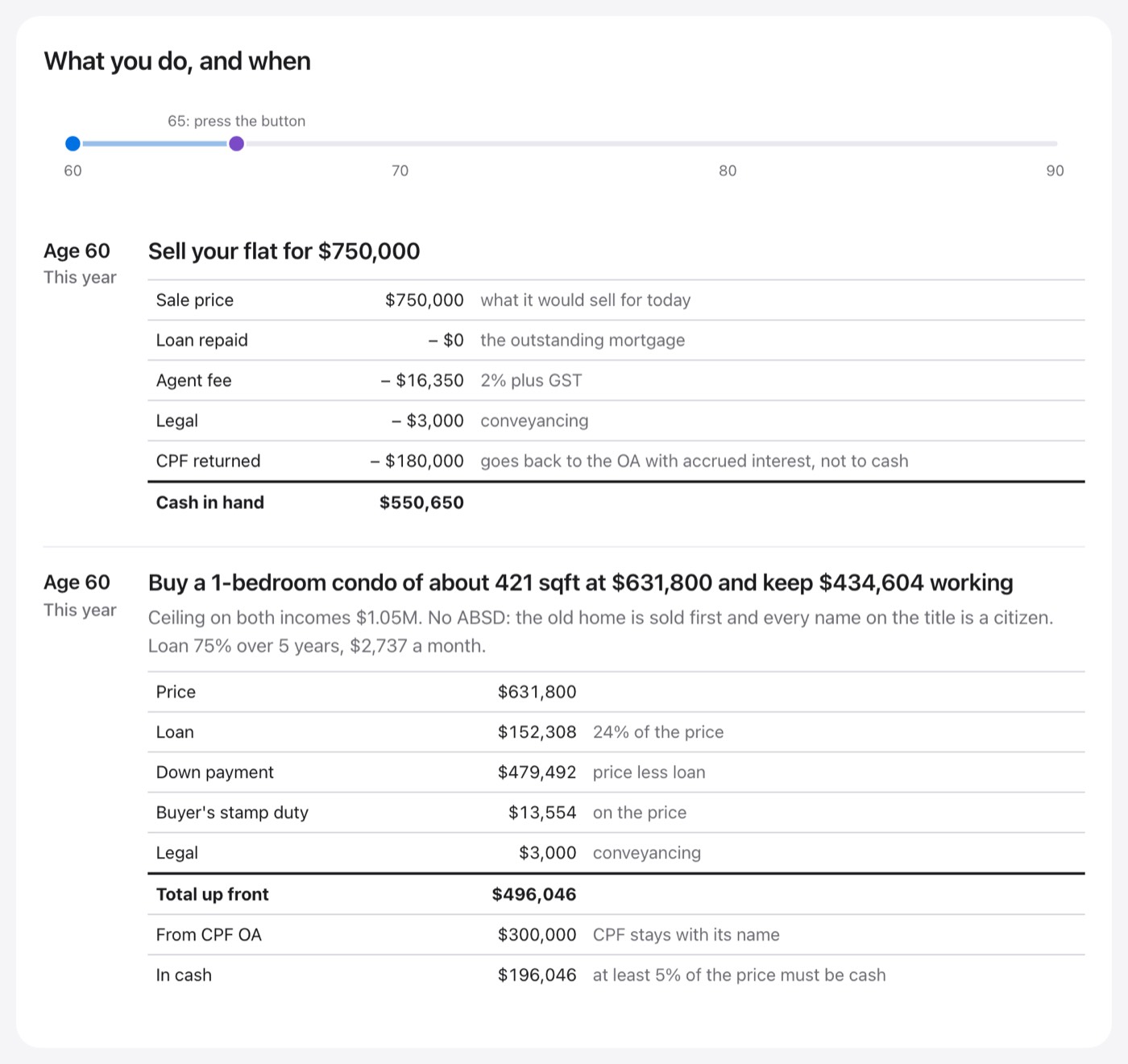
| The sale | |
|---|---|
| Sale price | S$750,000 |
| Agent fee (2% plus GST) | − S$16,350 |
| Legal | − S$3,000 |
| CPF returned to the Ordinary Accounts | − S$180,000 |
| Cash in hand | S$550,650 |
The tool sizes the next home to what the bank would lend and what keeps money working: a 1-bedroom condominium of about 421 square feet at S$631,800, a short loan over five years at S$2,737 a month, and S$434,604 kept invested. The move turns a home that pays nothing into a smaller home plus a pot that pays, at the cost of a loan into their mid-sixties.
Building a care reserve
- Estimate premiums by age from MOH's published figures, rising towards 85.
- Add out-of-pocket costs and a margin for care.
- Hold part of it in cash you can reach quickly; Freedom Age's buckets keep a cash reserve for this.
- Revisit it every few years; premiums and rules change.
The three schemes, and what each is for
| Scheme | What it covers |
|---|---|
| MediShield Life | National insurance for large hospital bills and selected costly outpatient treatments, sized for Class B2 and C wards in public hospitals |
| Integrated Shield Plan | Private insurance on top of MediShield Life, for higher ward classes or private hospitals |
| CareShield Life | Long-term care insurance paying a monthly cash payout for life while you cannot do three or more activities of daily living; S$662 a month for a claim in 2025, rising each year until 67 or a claim |
CareShield Life is compulsory for citizens and permanent residents born in 1980 or later, who join at 30; older cohorts were able to join. Hospital cover and care cover solve different problems: a plan needs both.
What a household can do now
- Keep MediShield Life in force and decide deliberately on any Integrated Shield Plan and rider, whose premiums rise with age.
- Know your CareShield Life status and payout.
- Hold a cash reserve for care that insurance does not cover.
- Plan where you would live if stairs or distance become hard: a smaller, accessible home is part of a care plan.
Common mistakes
- Budgeting today's premium. Premiums climb with age; budget the premium at 75 and 85.
- Relying on hospital cover for care. Long-term care is a separate cost.
- Keeping every dollar in the home. A home that cannot be drawn on does not pay a care bill.
The bottom line
Healthcare costs rise with age while a level payout does not. Keep hospital cover and care cover in place, hold a reserve that can grow, and know how your home could fund care if it is needed.
See a worked example in Freedom Age, then find the age your own home could start paying you: five questions, free.
Open the worked example
Questions people ask
- How much are MediShield Life premiums at 85?
- About S$1,560 to S$2,016 a year once the 2025 to 2028 increases are fully phased in, before subsidies (MOH).
- Are healthcare costs a big worry for Singaporeans?
- Yes: 56% named healthcare costs in Prudential's 2025 SG60 poll, second only to the cost of living.
- Does CPF LIFE rise to cover medical costs?
- Only the Escalating Plan rises, by 2% a year. Premiums rise faster with age, so a separate reserve is prudent.
- Should I sell my home to pay for care?
- Not necessarily; Lease Buyback or right-sizing can release money while you stay housed. Compare them on your numbers.
- What is the difference between MediShield Life and CareShield Life?
- MediShield Life helps pay large hospital bills; CareShield Life pays a monthly cash payout for long-term care when you cannot do three or more activities of daily living (MOH).
- How much does CareShield Life pay?
- S$662 a month for a successful claim in 2025, and the payout rises each year until 67 or a claim, whichever is earlier (MOH).