What your CPF LIFE payout will really buy in 20 years

CPF LIFE's Standard Plan pays the same dollars every month for life: about S$1,780 at the 2026 Full Retirement Sum. Prices do not stand still. At 2% a year, prices rise by about half in 20 years, so at 85 that S$1,780 buys what roughly S$1,200 buys today. The Escalating Plan starts lower and rises 2% a year; a home that pays you is the other way to close the gap.
The payout is fixed; prices are not
For members turning 55 in 2026, CPF puts the Basic Retirement Sum at S$110,200, the Full at S$220,400 and the Enhanced at S$440,800, paying an estimated S$950, S$1,780 and S$3,440 a month from 65 on the Standard Plan. Those payouts are level: the same number at 66 as at 86.
Inflation works the other way. The arithmetic is simple: at 2% a year, a basket that costs S$100 today costs S$100 × 1.0220 = about S$149 in 20 years. Divide the payout by that factor to see it in today's money: S$1,780 ÷ 1.49 = about S$1,200.
| Years after the first payout | S$1,780 in today's money at 2% inflation | At 3% |
|---|---|---|
| 5 | about S$1,610 | about S$1,540 |
| 10 | about S$1,460 | about S$1,320 |
| 20 | about S$1,200 | about S$990 |
What the last four years did
Singapore's inflation was not a steady 2%. Core inflation, the measure MAS watches, ran at 4.2% in 2023, 2.8% in 2024 and 0.7% in 2025, and was back at 2.0% in July 2026 (headline 2.2%), pushed by electricity and gas, services and food. MAS expects both measures between 1.5% and 2.5% for 2026. The lesson for a 20-year retirement is that a few hot years do most of the damage, and nobody can tell you in advance which years they will be.
Standard or Escalating
CPF LIFE's Escalating Plan starts with a lower payout and raises it by 2% every year, in the month of your first payout. CPF's own example: a payout that starts at S$1,000 at 65 reaches about S$1,500 by 85. It protects the later years at the cost of the earlier ones. The 2% is fixed, not matched to actual inflation, so a run of 4% years still outpaces it.
The gap your home could fill
For most owners the largest asset is not CPF; it is the home. A household that keeps its property until the day it chooses to sell, then turns the proceeds into a paid-off home, a rental and a dividend pot, has a second income that rises with rents rather than staying flat. Freedom Age works out the age at which that could happen on your own numbers, alongside what CPF LIFE pays.
A worked example: a single owner of 50
The worked example follows a single owner of 50 in a 4-room flat in District 23 worth S$560,000, with S$60,000 of loan left and S$140,000 of CPF used. They earn S$6,500 a month and want S$3,000 a month in retirement.
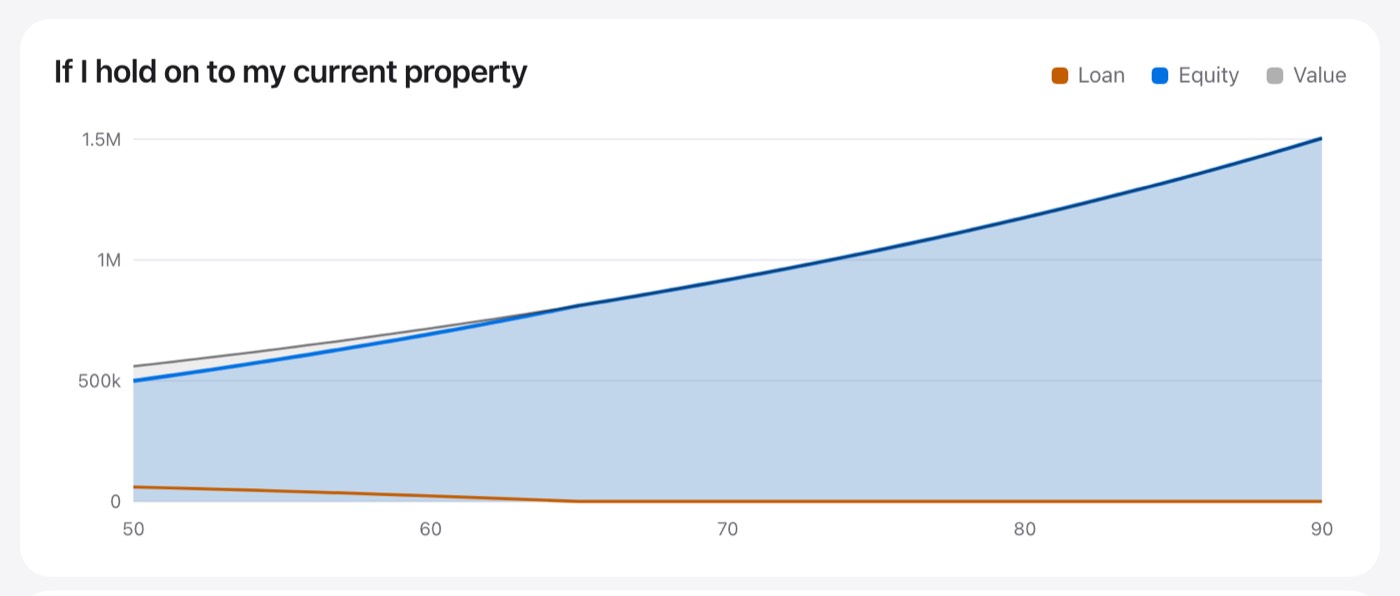
Held to 65, Freedom Age shows the flat worth about S$811,047, fully paid. Their chosen move is to sell and buy smaller while keeping money working.
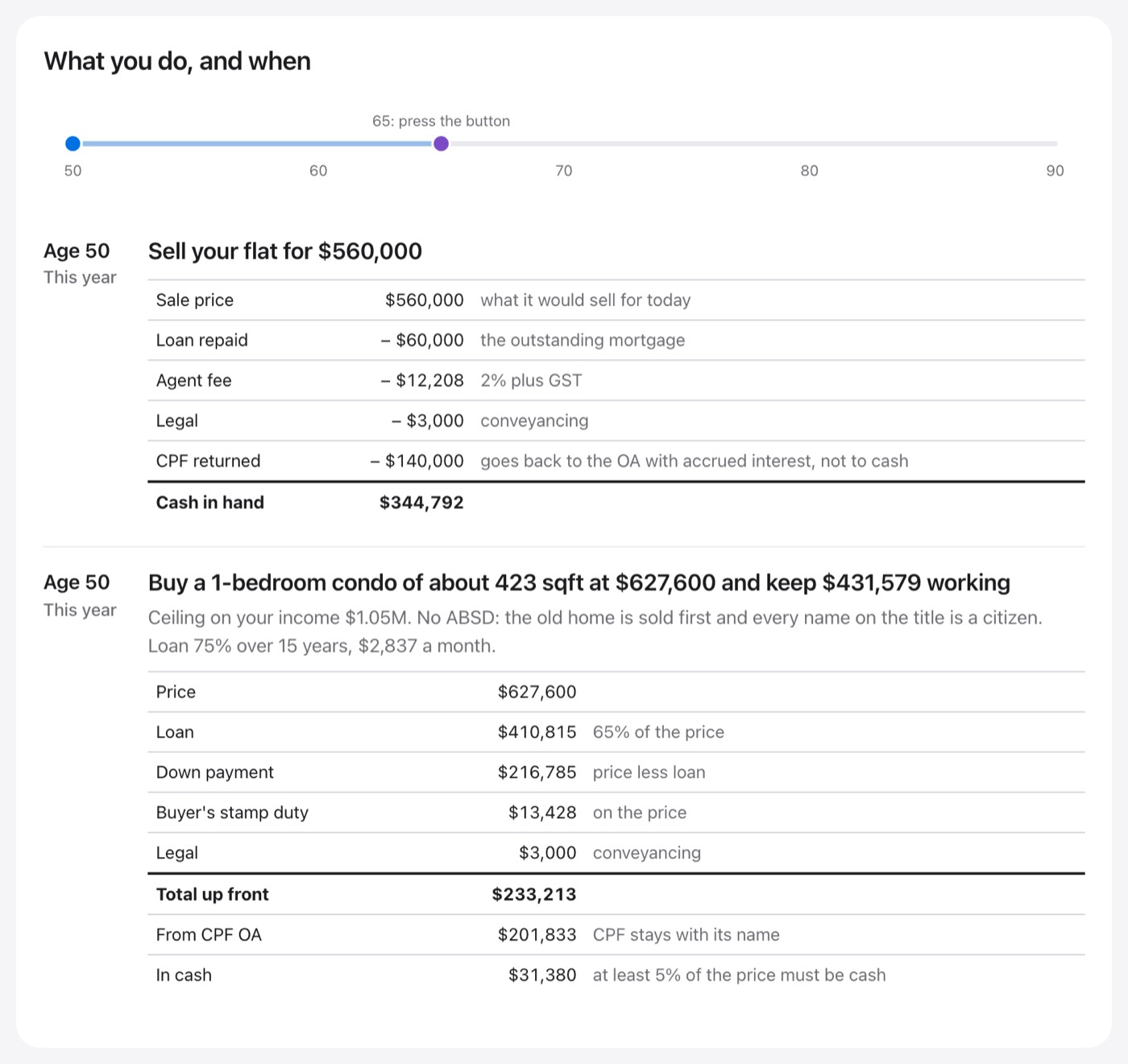
The sale leaves S$344,792 in cash after the loan, S$12,208 in agent fees, S$3,000 legal and S$140,000 back to CPF. The next home is a 1-bedroom condominium of about 423 square feet at S$627,600 on a 15-year loan at S$2,837 a month, with S$431,579 kept working. CPF pays 53% of the instalment; S$1,342 a month comes from salary until the loan ends.
A household's own inflation
The CPI averages everyone's spending. A retiree's basket leans towards food, utilities and healthcare, the very items that pushed inflation up in July 2026 (electricity and gas, services and food). Two households with the same CPF LIFE payout can feel very different inflation.
Three ways to protect the later years
- Choose the Escalating Plan if you can live on a lower start; it rises 2% a year.
- Hold part of your wealth in something whose income can rise, such as rent.
- Delay the start of CPF LIFE if you have other income until then; each year of deferral raises the payout.
Work out your own payout in today's money
Take your estimated CPF LIFE payout and divide it by (1 + inflation) raised to the number of years since your payouts began. At 2%, divide by 1.10 after 5 years, 1.22 after 10, 1.35 after 15 and 1.49 after 20. At 3%, by 1.16, 1.34, 1.56 and 1.81.
Common mistakes
- Using headline inflation from one good year. 2025's 0.7% core rate followed 4.2% in 2023.
- Assuming the Escalating Plan fully protects you. It rises 2% a year whatever prices do.
- Leaving the home out of the plan. Rent can rise with prices where a fixed payout cannot.
The bottom line
A level CPF LIFE payout loses about a third of its buying power over 20 years at 2% inflation. The Escalating Plan, deferral and an income that can rise, such as rent, are how households protect the later years.
See a worked example in Freedom Age, then find the age your own home could start paying you: five questions, free.
Open the worked example
Questions people ask
- Does CPF LIFE increase with inflation?
- The Standard and Basic Plans pay a level amount. The Escalating Plan rises by a fixed 2% a year, which is not matched to actual inflation.
- How much is S$1,780 a month worth in 20 years?
- At 2% inflation, about S$1,200 in today's money; at 3%, about S$990. Divide by 1.02 or 1.03 raised to the number of years.
- What was Singapore's inflation in 2025?
- Core inflation averaged 0.7% and headline 0.9% in 2025, after 2.8% and 2.4% in 2024 (MTI).
- Is 2% a realistic inflation assumption?
- MAS forecasts 1.5% to 2.5% for 2026; core inflation averaged 4.2% in 2023 and 0.7% in 2025, so a plan should test a higher rate too.
- What is S$1,780 worth after 10 years of 2% inflation?
- About S$1,460 in today's money: S$1,780 ÷ 1.02^10.