The cost of waiting: what three years of delay could do

Waiting feels free; it is not. Each year of delay is a year less for a larger asset to grow, a shorter loan the bank will give, and a year of inflation on the income you will need. With HDB resale prices easing (down 0.1% and 0.3% in the first two quarters of 2026) and core inflation back at 2.0%, the question is not whether prices will fall further but what the delay costs you in years.
Why 2026 is different
HDB resale prices rose 9.7% in 2024 and 2.9% in 2025, then fell 0.1% in the first quarter of 2026 and 0.3% in the second: the first two falling quarters in about seven years. Private home prices rose 0.5% in the second quarter. More flats reach their MOP each year to 2028, adding supply. Timing a market is uncertain; timing your own years is not.
The two clocks
A household has a price clock and an age clock. The price clock can move either way. The age clock only moves one way: every year of delay shortens the loan tenure a bank will offer, raises the instalment on any purchase, and leaves fewer years for the asset to compound before the day you choose to sell.
A worked example
Freedom Age's worked example follows a couple of 34 and 33 whose 4-room flat has just reached its MOP, and the same couple three years later at 37 and 36 with the same flat and savings. Open both examples below and compare the moves each can make and when each could start to be paid by their home.
When waiting is right
Waiting is right when the numbers do not clear the bank yet, when the buffer is thin, or when a life event (a child, a job change) is close. It is costly when it is only hesitation. The answer depends on your numbers, which is what Freedom Age is for.
A worked example: the same couple, three years apart
Freedom Age ran the same household twice: a couple of 34 and 33 at their MOP, and the same couple three years later at 37 and 36, with the same flat, the same incomes and the loan paid down by three years. Both runs use today's prices, so the difference is time, not the market.
| Now (34 and 33) | Three years later (37 and 36) | |
|---|---|---|
| Cash in hand after selling the flat | S$153,484 | S$183,484 |
| Condominium bought | S$1,569,000 | S$1,669,000 |
| Loan tenure | 30 years | 29 years |
| Monthly instalment | S$4,961 | S$5,390 |
| Paid from salary each month | S$1,856 | S$2,285 |
| Reserve to hold (six months) | S$29,767 | S$32,340 |
| The flat kept instead, value at 65 | about S$1.37 million | about S$1.27 million |
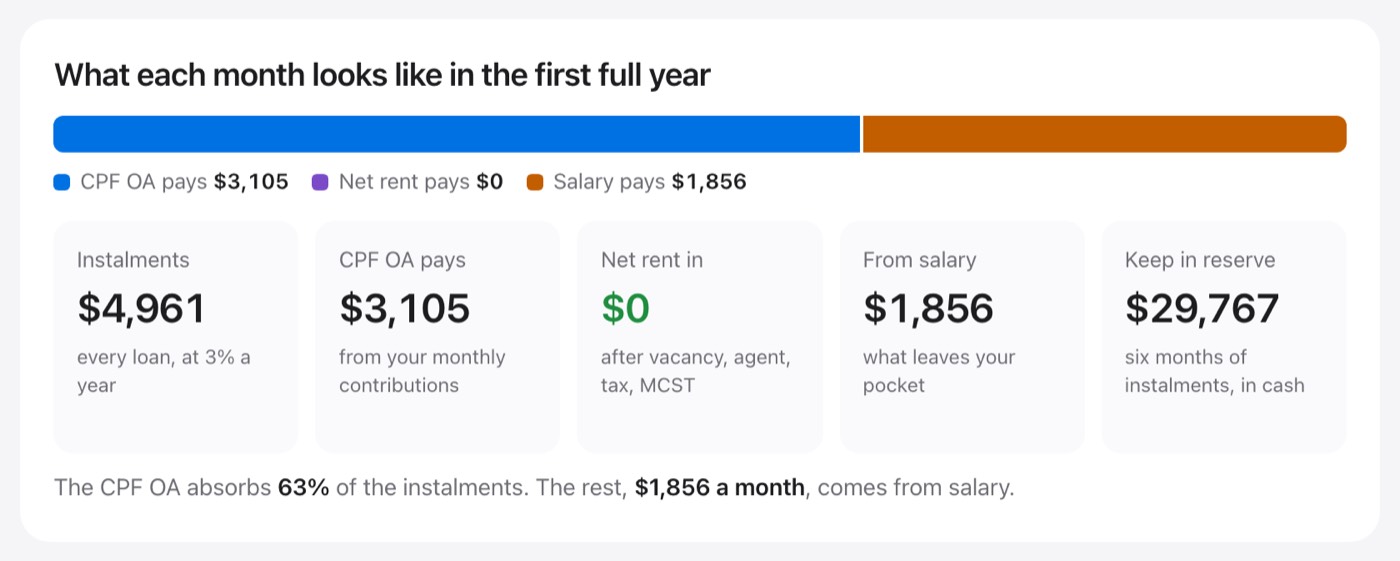
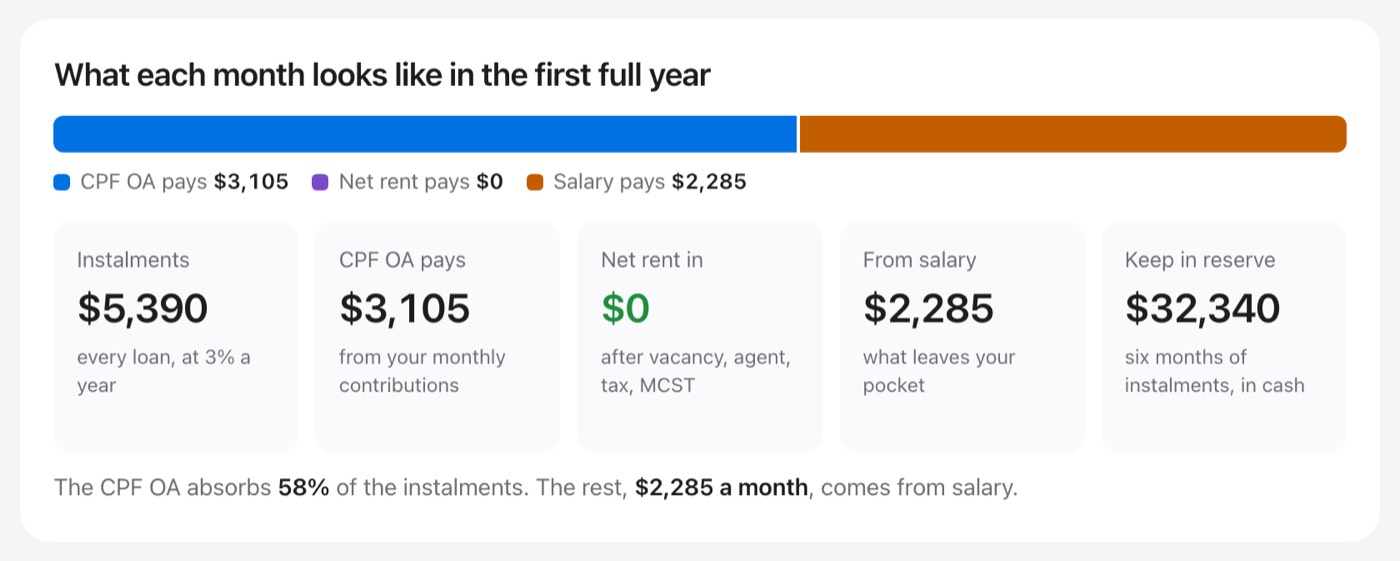
Three years of waiting gave them S$30,000 more cash from paying down the loan, but cost S$429 a month more from salary, a year off the loan, and, on the hold path, about S$100,000 less at 65 because the flat had three fewer years to grow before it. The price clock might move in their favour; the age clock only moves one way.
When waiting does make sense
- Your numbers do not clear the bank yet, even with a smaller home.
- Your reserve is below six months of instalments.
- A life event is near: a child, a job change, a parent's care.
- You are within a year of your MOP and cannot yet sell.
Why a shorter loan costs more than it looks
Take the same S$1.2 million loan at 3% a year. Over 30 years the instalment is about S$5,059 a month; over 25 years about S$5,690, some S$630 more. Seen the other way, a household whose income supports S$5,059 a month can borrow S$1.2 million over 30 years but only about S$1.07 million over 25: roughly 11% less house for the same salary. Every year of waiting moves you along that line.
Supply is rising, too
HDB expects more flats to reach their MOP each year: 8,000 in 2025, 13,500 in 2026, 15,000 in 2027 and 19,500 in 2028. More supply is one reason resale prices have eased, and it is a fact to weigh, not a forecast that prices will fall.
Common mistakes
- Waiting for a price dip without a date. Set a date by which you decide, and what would change your mind.
- Counting only the price. Count the loan tenure, the instalment and the years of growth too.
- Forgetting that savings also age. Cash waiting for a better price earns little while it waits.
The bottom line
The price clock can move either way; the age clock only moves one way. In the worked example, three years of waiting cost $429 a month more from salary and about $100,000 less at 65 on the hold path.
See a worked example in Freedom Age, then find the age your own home could start paying you: five questions, free.
Open the worked example
Questions people ask
- Are HDB resale prices falling in 2026?
- The HDB resale price index fell 0.1% in Q1 and 0.3% in Q2 2026, after rising 2.9% in 2025 and 9.7% in 2024.
- Is it better to wait for prices to drop?
- Waiting trades an uncertain price saving for a certain loss of time: a shorter loan and fewer years of growth. Compare both on your own numbers.
- How does age affect my housing loan?
- Loan tenure is capped by age (loans generally run to 65), so each year of delay shortens the tenure and raises the instalment.
- How much does waiting three years cost?
- In Freedom Age's example, S$429 a month more from salary for a similar condominium and about S$100,000 less at 65 on the hold path.
- How does a shorter loan tenure affect what I can buy?
- At 3%, a monthly budget that carries S$1.2 million over 30 years carries about S$1.07 million over 25 years, roughly 11% less.