Your child's degree or your retirement? The real trade-off for Singapore parents

Help for young children is rising, but the big education bill comes at university, when most parents are in their late forties or fifties and have the fewest years left to rebuild savings. A degree can be funded by loans, bursaries and the CPF Education Loan Scheme; a retirement cannot be borrowed for. Plan the retirement first, then decide how much of the degree the family pays.
Why the timing hurts
A child who starts university at 19 or 20 usually does so when the parents are between their mid-forties and mid-fifties. Those are the years when a household's loan tenure shortens, bank lending on a new purchase falls, and every dollar taken out has fewer years to grow back. The same S$100,000 means less at 50 than at 35 because it has 15 fewer years to compound before 65.
What the State already carries
Support for young children has grown. Full-day childcare fees are capped from January 2026, and the National Day Rally in August 2026 announced further cuts to childcare and infant care fees by 2030 and a larger child support package from April 2027 (check the official figures before relying on them). Subsidised local university places for citizens are priced well below full cost; the current fees are on each university's fee page.
What CPF can and cannot do
The CPF Education Loan Scheme lets a parent pay a child's subsidised tuition fees from the parent's Ordinary Account, which the child repays after graduating. It is a loan to your child from your retirement money: useful, but every dollar out of the OA is a dollar not earning 2.5% towards your own retirement until it comes back.
Your retirement cannot take a loan
Students can borrow, take bursaries and work. Retirees cannot borrow against the years they did not save. Sun Life's 2026 survey found that 80% of high-income Singaporeans expect to support their children or relatives in retirement, and caring for both generations has led 45% to postpone retirement. Planning the retirement first protects the children from becoming the support later.
Using the home without spending the future
For many parents the home holds more than CPF and savings combined. Keeping it and adding a rental, right-sizing after the children leave, or timing a sale to the year the last one graduates are all ways to fund both. Freedom Age runs these side by side for a family's own numbers.
A worked example: parents of 44 and 42 with two teenagers
The worked example follows parents of 44 and 42 in a District 20 condominium worth S$1.4 million, with S$600,000 of loan left and S$300,000 of CPF used. They earn S$12,000 and S$8,000 a month and want S$7,000 a month in retirement. Their first choice was to keep the home and add a rental; on their numbers the bank will not lend enough for it, and Freedom Age says so before showing what does clear.
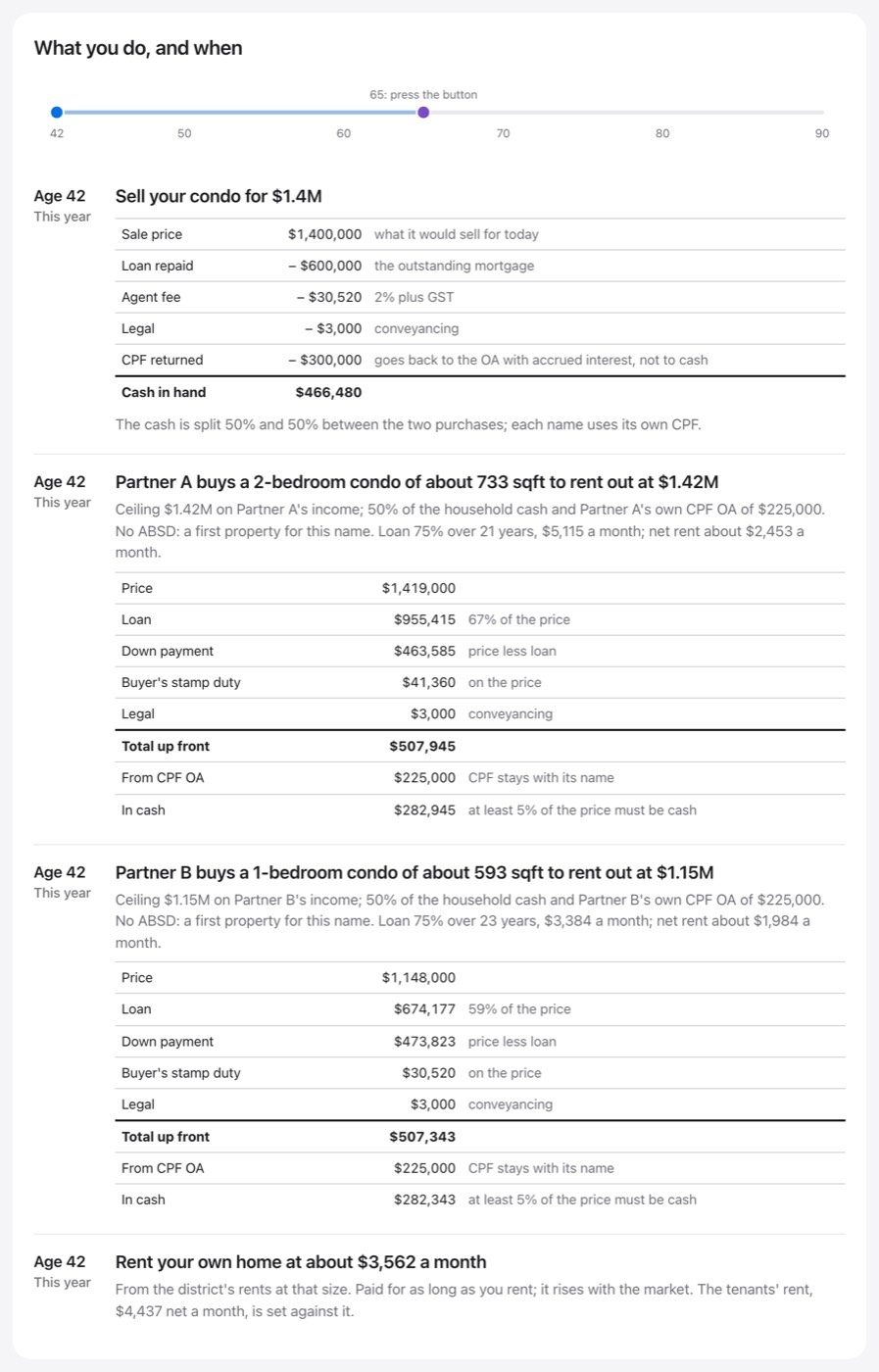
Selling leaves S$466,480 after the loan, fees and S$300,000 returned to CPF. Each parent then buys a rental in their own name (a 2-bedroom of about 733 square feet at S$1.42 million, and a 1-bedroom of about 593 square feet at S$1.15 million), and the family rents its own home at about S$3,562 a month. The tenants' rent, about S$4,437 net a month, is set against it.
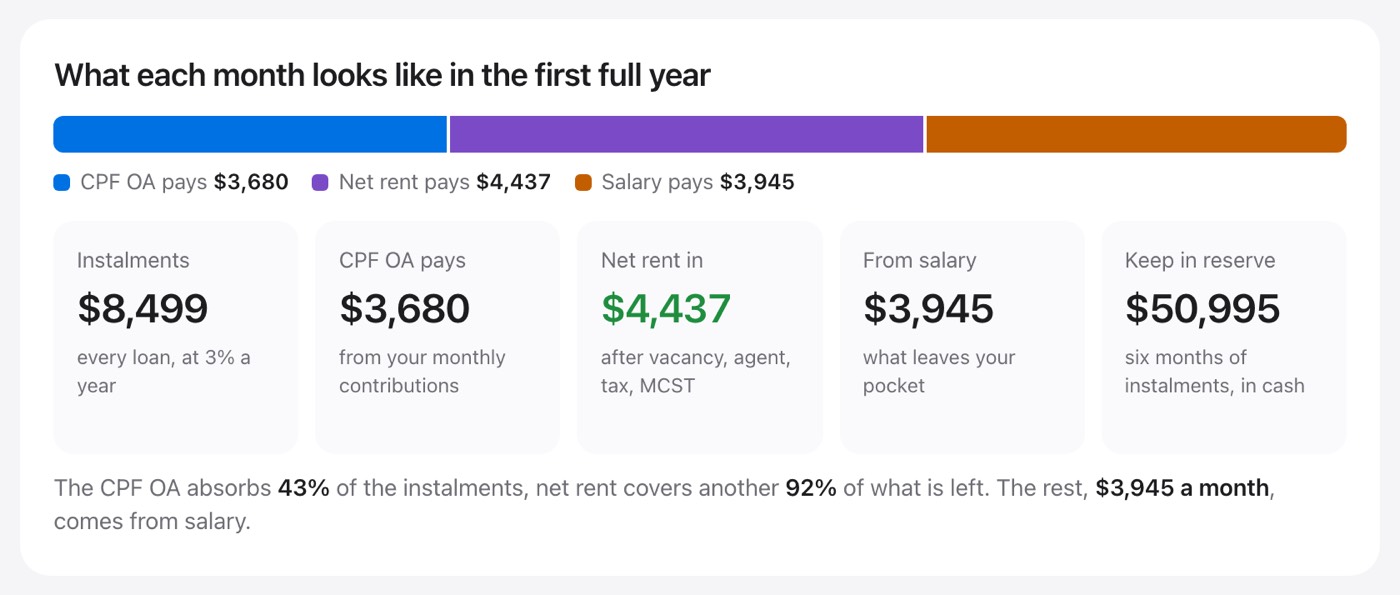
The cost is real: S$8,499 a month in instalments, of which CPF pays S$3,680 and net rent another share, leaving S$3,945 from salary, with a reserve of S$50,995. It is the kind of plan that has to be weighed against university years, not made in spite of them.
A timeline to plan against
| Your age (example) | Child | What to settle |
|---|---|---|
| Early 40s | Secondary school | Your home and retirement plan; the bank still lends long |
| Mid 40s | Junior college or polytechnic | University funding: savings, CPF Education Loan Scheme, bursaries |
| Late 40s to 50s | University | Protect your retirement reserve; avoid new long loans |
Questions to ask as a family
- Local or overseas, and what each costs today on the universities' own fee pages?
- How much of it will the family pay, and how much will the student borrow?
- Which part comes from CPF under the CPF Education Loan Scheme, and when is it repaid?
- What does it do to the age your home could pay you?
The bottom line
A degree can be funded by loans, bursaries and the CPF Education Loan Scheme; a retirement cannot be borrowed for. Settle your retirement plan first, then decide how much of the degree the family pays.
See a worked example in Freedom Age, then find the age your own home could start paying you: five questions, free.
Open the worked example
Questions people ask
- Can CPF pay my child's university fees?
- Yes. Under the CPF Education Loan Scheme a parent can pay a child's subsidised tuition fees from their Ordinary Account; the child repays the principal and the 2.5% interest to the parent's account, starting a year after graduating.
- Should parents pay for university or save for retirement first?
- A degree can be funded by loans, bursaries and the CPF Education Loan Scheme; retirement cannot be borrowed for. Most plans are safer when retirement is secured first.
- When should we start planning for both?
- Before the eldest turns ten, while there are still ten or more years for savings and property to grow.
- Can both parents use CPF for one child's fees?
- The CPF Education Loan Scheme allows a parent's Ordinary Account to be used within its limits; check CPF's rules for using more than one account.