The best inheritance is not needing your children's allowance

Leaving the family home intact feels like the most loving thing a parent can do. But a Singaporean who reaches 65 lives, on average, to about 86.6, so the children inherit in their fifties or sixties, often after years of paying an allowance. A home that pays its owners in retirement can be the better gift: parents who never need the allowance, and children who keep their own retirement on track.
When the children actually inherit
Life expectancy at 65 is 84.9 for men and 88.1 for women (SingStat, June 2026). Children of parents who retire at 65 are typically in their thirties then, and in their fifties or sixties when they inherit. By then the inheritance arrives too late to help with their own home or their children's education.
The hidden cost of an intact home
If the home is kept whole while the parents run short, the children pay the difference as an allowance, often for twenty years. Sun Life's 2026 survey found 80% of high-income Singaporeans expect to support their children or relatives in retirement. A home that stays whole can cost the children more than it leaves them.
Monetise, then decide what to leave
Selling part of the lease (Lease Buyback), right-sizing (with the Silver Housing Bonus of up to S$40,000 for a 3-room or smaller flat), or renting part of the home all keep the parents independent. What is left, in CPF, cash and the smaller home, still passes on. Freedom Age shows how much the home could pay and from when, so a family can see both sides before choosing.
The conversation
The hardest part is not the arithmetic; it is telling the children. A plan with numbers on it makes the conversation easier: here is what our home can pay us, here is what we will leave, and here is why you will not need to send us money.
A worked example: a couple of 62 and 60 in a fully paid 5-room flat
The worked example follows a couple of 62 and 60 in a fully paid 5-room flat in District 18 worth S$750,000, with S$180,000 of CPF used on it. They earn S$4,000 and S$2,000 a month and want S$3,500 a month in retirement.
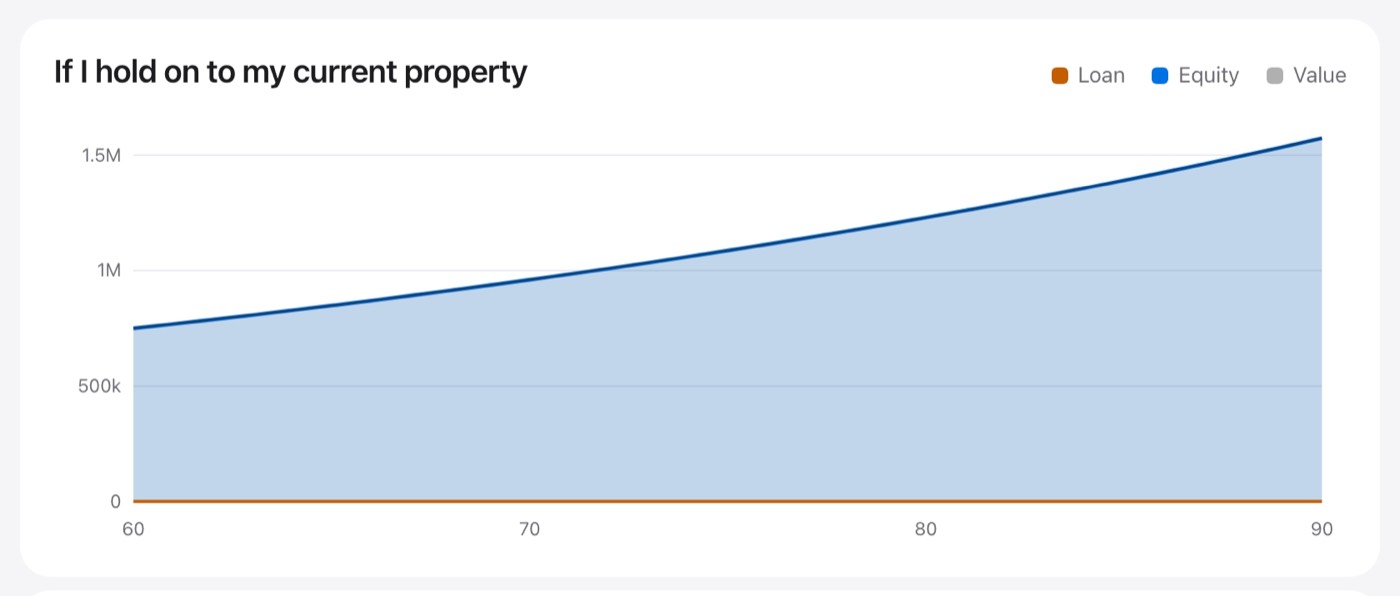
Keeping the flat, Freedom Age shows it worth about S$848,556 at 65, with nothing owed. That is wealth, but not income: it pays nothing a month until something is done with it. Their chosen move is to sell and buy a smaller home with cash in hand.
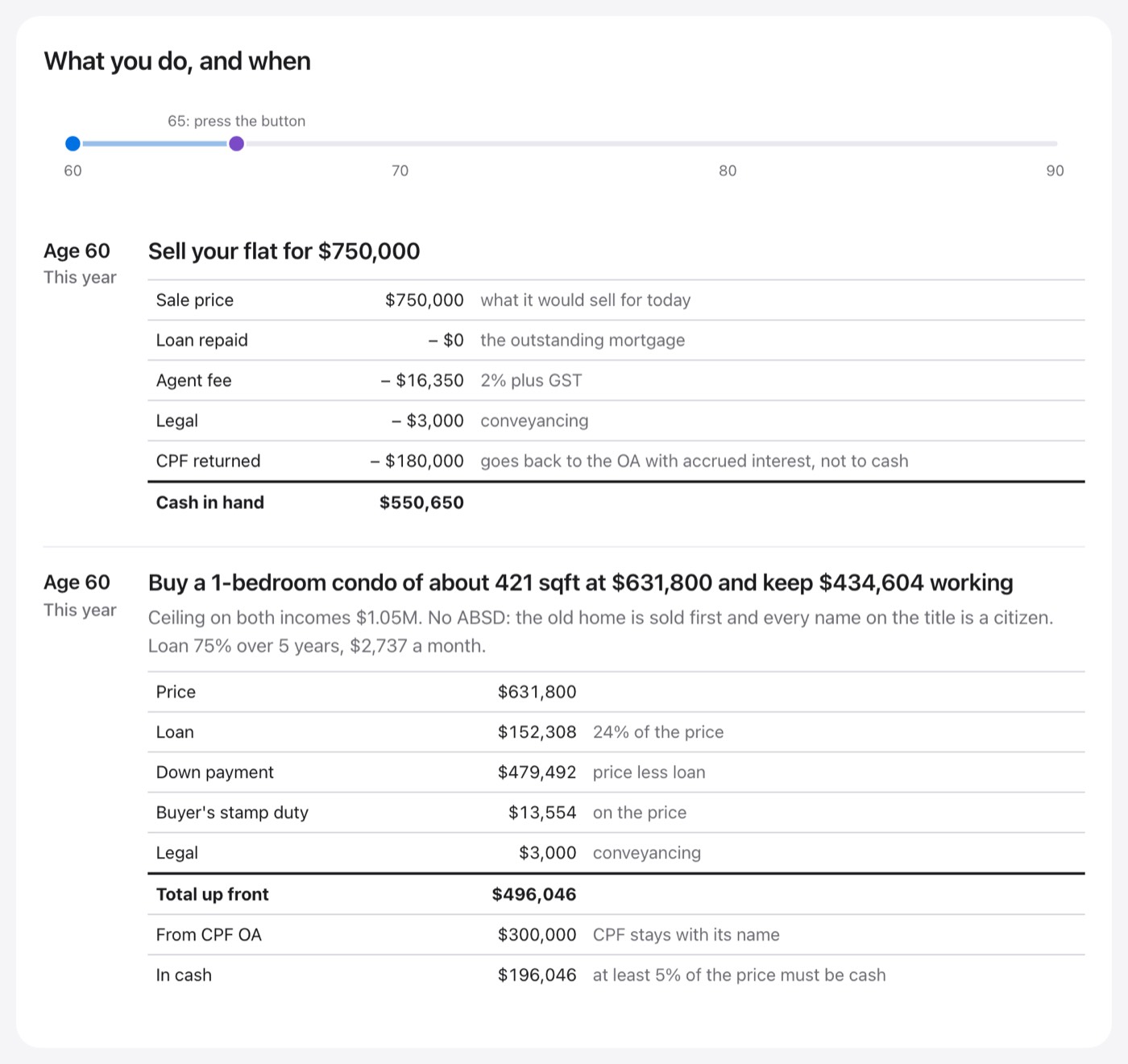
| The sale | |
|---|---|
| Sale price | S$750,000 |
| Agent fee (2% plus GST) | − S$16,350 |
| Legal | − S$3,000 |
| CPF returned to the Ordinary Accounts | − S$180,000 |
| Cash in hand | S$550,650 |
The tool sizes the next home to what the bank would lend and what keeps money working: a 1-bedroom condominium of about 421 square feet at S$631,800, a short loan over five years at S$2,737 a month, and S$434,604 kept invested. The move turns a home that pays nothing into a smaller home plus a pot that pays, at the cost of a loan into their mid-sixties.
What your children actually receive, and when
| Keep the home whole | Monetise part of it | |
|---|---|---|
| Your monthly income | CPF LIFE only | CPF LIFE plus what the home pays |
| Allowance from children | Often needed | Often not |
| What passes on | The whole home, later | A smaller home, cash and CPF, later |
Writing it down
- Write the plan and its numbers on one page.
- Name who inherits what, and make or update your will.
- Tell your children why they will not need to support you.
How long the money has to last
| At 65, expected to live to (SingStat 2024 to 2025) | |
|---|---|
| Men | 84.9 |
| Women | 88.1 |
| Everyone | 86.6 |
A plan that starts at 65 should run past 90 to be safe. The years after 80 are the ones most likely to need care, and the ones in which a level income buys least.
Three ways to keep independence and still leave something
- Lease Buyback: stay at home, keep a shorter lease, leave the flat (with less lease) and your CPF balances.
- Right-sizing: move to a smaller home, keep the difference working, leave the smaller home and the savings.
- Renting a room: keep the whole flat, add income, leave the whole flat.
Each keeps you off your children's payroll; each leaves something different. The worked example above shows the right-sizing route for a couple of 62 and 60.
Common mistakes
- Deciding for the children without asking them. Many would rather you lived well.
- Waiting until care is needed. Moves are easier at 62 than at 82.
- No will. Whatever you choose, write it down.
The bottom line
Leaving the home whole can cost your children years of allowance. A plan that makes your home pay you, and says what passes on, can be the better inheritance.
See a worked example in Freedom Age, then find the age your own home could start paying you: five questions, free.
Open the worked example
Questions people ask
- Will selling part of the lease hurt my children's inheritance?
- It reduces the flat's value at the end, but it may also spare them years of allowance. Compare both on your numbers.
- How long do Singaporeans live after 65?
- On average to about 86.6: 84.9 for men and 88.1 for women (SingStat, 2024 to 2025 life tables).
- How do I talk to my children about it?
- Start with the plan and its numbers: what the home pays you, what you will leave, and why they will not need to support you.
- Should I sell my home before I die or leave it to my children?
- It depends on what you need to live on. A plan that shows both sides, on your numbers, makes the choice clear.
- Can I leave my HDB flat to my children if I join the Lease Buyback Scheme?
- The flat still passes on, with the shorter lease you kept, together with your remaining CPF savings under CPF's rules.